Clara’s PEC cards have velcro on the back so she can move them around, depending on what her routine needs to be on any given day. (Image submitted by Clara Kirby-McIntosh)
But there are other challenges that have been harder to overcome.
For Clara, it’s hard to learn new ideas quickly and she needs time to let thoughts sink in.
But because of COVID-19, many high school schedules have changed to be more fast-paced.
Clara started the term taking two classes each day, one in the morning and one in the afternoon.
After a few days, she decided to drop one due to the workload.
“I can already tell that is going to be a major struggle for me this year,” she said.
Michelle Obama with her mother, Marian Robinson, and brother, Craig Robinson.
It’s comforting to know that even a young Michelle Obama had temper tantrums.
U.S. First Lady was joined by her mother, Marian Robinson, and brother Craig Robinson on Wednesday’s finale of “The Michelle Obama Podcast,”. The discussion centred around raising children and all of the fear, chaos and joy that inspires.
Here are some of the parenting insights we learned from the Obama moms:
Invite your kids to question everything
“I used to tell you to question me, and you all sure did run that into the ground,” Marian quipped.
A significant way to teach kids to think critically is to indulge their curiosity, she explained. Even though it might get annoying, and even if you can’t always answer every question, it’s good to make sure kids keep asking questions.</p&gt;
Teach kids self-reliance early
This one was big in the Robinson household, apparently. When her kids’ alarm clocks rang in the morning, Marian used to tell them “You can lay in the bed if you want, I already have my education.”</p>
The result, for Obama, was learning to take responsibility for herself.
“I always felt like, I’m getting up for me,” she said. “I’ve gotta get ready to go to school, not because my mom is making me do it, but because she’s told me that I’m responsible for my education.”</p>
Her parents made sure she understood that she was responsible for her own behaviour, she said.
INSTAGRAM / MICHELLE OBAMA
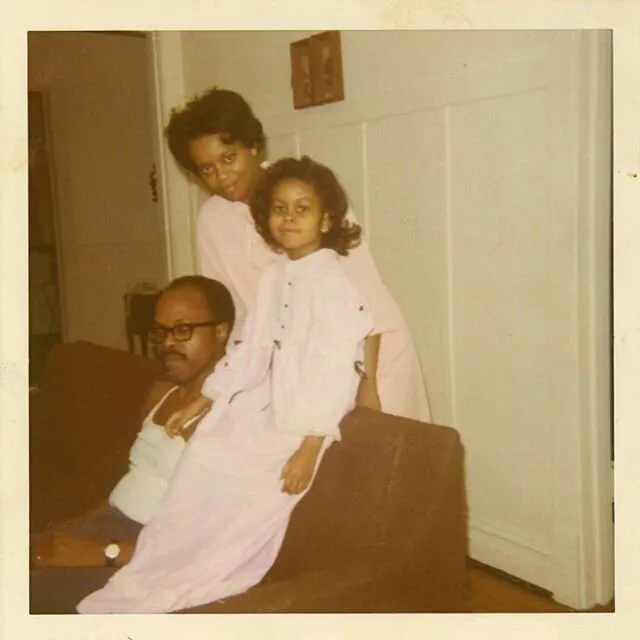
A young Michelle with her parents Marian and Fraser.
“That was also the beauty of you and Dad, is that you made our succe
sses and our failures our own,” Obama said. “You were always there for us, but you believed that ‘You get good grades for you, not for me.’ You never celebrated our victories too much, or you never wallowed in our failures too deeply. ”
It’s definitely hard for a parent to let go, Obama acknowledged, but it’s something she also put into practice with
her daughters Malia, now 22, and Sasha, 19.</p></p>
><p>“If you are looking for a child to be self-reliant when they’re 21, 22, you have to make them practice that as early as 5 or 6 or 7 years old,” she said.</p>
><p>“If you don’t teach a kid how to wake up on their own when they’re young and it’s easy, yeah, you could be waking them up for the rest of their lives because you don’t make them practice it.”</p>
Think of your kids as smart people, even when they’re babies
“A two-day-old baby is a smart person. Fraser taught me that,” Marian said, referring to her late husband and Michelle and Craig’s dad, Fraser C. Robinson III.
“He just decided he was having the smartest kids on earth. That’s the way I thought about you — I thought about you as people who can learn things.”
Even babies have personalities — her two kids did, Obama said. “They were infants when you could see, if you were paying attention, and spending time, and really, listening like your baby has something to tell you.”</p>
If you have several kids, remember that they’ll all have different needs
><p>Robinson and both her grown-up kids agreed that what worked for your first child might not work for your second — even when they’re still babies.</p>
This is where the temper tantrums come in — “You came that way,” Marian told her daughter. “You just were determined, you were gonna do it your way. Craig was acquiescent.”
“That’s some jiu-jitsu parenting!” Obama said, laughing.
Set the same expectations for all your kids, regardless of their gender
>class=”yoast-text-mark”>ass=”primary-cli cli cli-text “><p>Obama said one of the things she appreciated most about her late father was he treated his two kids the same way, even though one was a boy and one was a girl.</p>
<img class=”img-sized__img landscape” src=”https://img.huffingtonpost.com/asset/5f63d75b2400001e1792276b.jpeg?ops=scalefit_720_noupscale” alt=”Michelle and Craig as kids.” width=”720″ height=”717″ />
MICHELLE OBAMA / INSTAGRAM
Michelle and Craig as kids.
“As a young girl I got a feeling of empowerment because my dad respected my voice,” she told Craig. “He treated me as your equal, as his equal. If he taught you to do something, I learned how to do it… he was my first role model of what it meant to have a supportive loving man in my life.”</p>
Spend time with your friends who are also parents
<p>Both generations said they learned a lot about parenting and gained a ton of
support from their friends who were also parents. It was especially important when her husband was running for office, Obama said, but she thinks it would be helpful for all moms and dads.</p>
“All you’re doing when they were little is, you’re hoping you’re not messing them up,” she said. “You’re learning from what everybody else is doing.”
Don’t air resentments about the other parent in front of your kid
s </div>
<p>This was another one that Obama said became important in her life when her husband wa
s the p
resident and would often have to work or travel late. But all kinds of parents with all kind of jobs face challenges when it comes to co-parenting, whether they’re together or not. The healthiest approach is generally keeping the kids out of issues parents have with each other, for everyone’s sake.
s=”img-sized”>
INSTAGRAM / MICHELE OBAMA
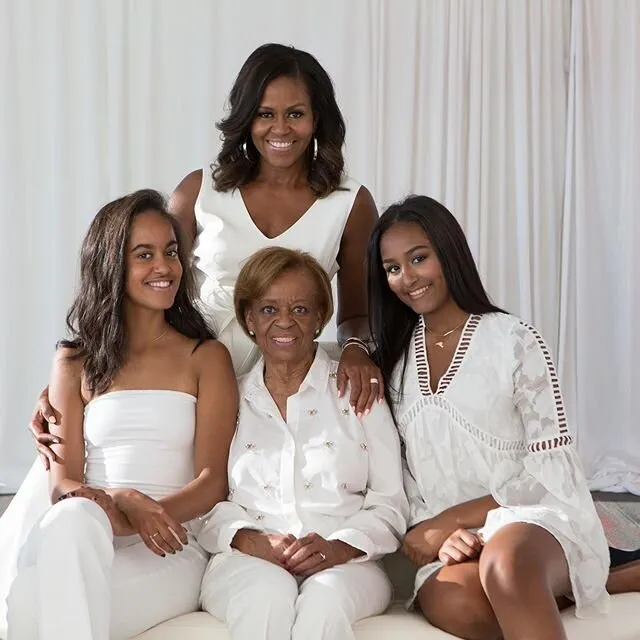
Michelle Obama with her daughters Malia (left) and Sasha (right), and her mother Marian Robinson.
“I tried to make sure that I wasn’t pouting in front of the kids when Barack wasn’t there,” Obama said. “If I had made a big deal of it, and said, ‘Oh my god, your dad’s not here again,’ ‘Oh, he’s missing this,’ that’s the signal to them: ‘This isn’t normal.’”</p></p>
><p>But her husband did try his hardest not to let his work interfere with important family time, she said, which made it easier for her to brush it off when it really was unavoidable.</p>
Do your best not to let racism “cancel out” the important messages you teach your kids
><p>When Craig was 11, police officers accused him of stealing a bike that was a gift from his parents — the kind of racial profiling that so many Black people have to put up with. He explained to the cops that the bike was his and invited them to go to his house and ask his parents.</p>
><p>When they did, Marian insisted that the cops apologize to Craig, explaining to them that “what you did was cancel out a whole lot of things that we had been teaching [our kids]. I think you need to come back here to talk to them and at least admit you made a serious mistake.”</p>
><p>Obama and her brother have both had to have the difficult conversation with their kids about how, as Black people, they’re treated differently. That conversation is a really painful one, Marian said.
ss=”img-sized__placeholder”>
SOPA IMAGES VIA GETTY IMAGES
A protester wears a Barack Obama hoodie during a Black Lives Matter demonstration in the U.K.
It’s “such a way of life when it comes to interacting with the rest of the world,” she said. “Nobody thinks about the fact that we all come from good families that are trying to teach values. But when you leave the safety of your home and go out into the street, where being Black is a crime in and of itself, we have all had to learn how to operate outside of our homes with a level of caution and fear.”</p>
><p>But Obama said she’s energized by the Black Lives Matter protests, and finds hope in the fact that young Black people who have to learn to live with prejudice are likely to build up more empathy for other groups.</p>
<p>“If you have a good foundation, you are so strong, that you can overcome that. You know, because you are so resilient, because you have had to learn so much empathy and so much self control.”</p> </div>
Accept that you don’t have all the answers
<
p>Parenting, to put it mildly, comes with a lot of pressure. “With each generation they’re making parenting harder, they’re making the bar crazier, like, for what a parent is supposed to do,” Obama said. “Here we come with all the rules and all the guidebooks, and we still feel unprepared.”
But everything about parenting is always going to be a work in progress, Marion told her.
“Parents think they have to know all the answers,” Marion said. “And nobody knows all the answers. I was very comfortable saying, ‘I don’t know.’”
It helps literacy and emotional growth, but that’s not all, a new survey reveals.
By Valerie Howes
We know kids thrive on routines and rituals: The predictability helps them feel secure, develop good habits and learn to better regulate their own emotions.
Sometimes it can feel like a drag for parents to live life on a schedule, but a recent survey revealed there’s one routine most parents love as much as their kids do: bedtime stories.
In fact, story time even ranked higher in popularity among parents than bath time and cuddle time ― although as any book-loving mom or dad will tell you, reading and cuddling tend to be a package deal, when it comes to the bedtime routine.
Watch this video below to learn more about parents’ thoughts, habits and preferences around story time.
Eighty-six per cent of parents love telling stories to their kids before bedtime, according to this survey of 2,000 parents conducted by OnePoll, on behalf of customized children’s book publisher Wonderbly. In fact, three in four wish they could never stop telling stories to their kids, as they grow older, and describe bedtime stories as the most quality time they get with their children in the typical day. Since it’s such a peaceful and cozy ritual, with opportunities for one-on-one conversations, it’s excellent for bonding.
So when does it all begin? Twenty per cent of parents start reading to their children before they are even born. And 15 per cent start from the time their child enters the world.
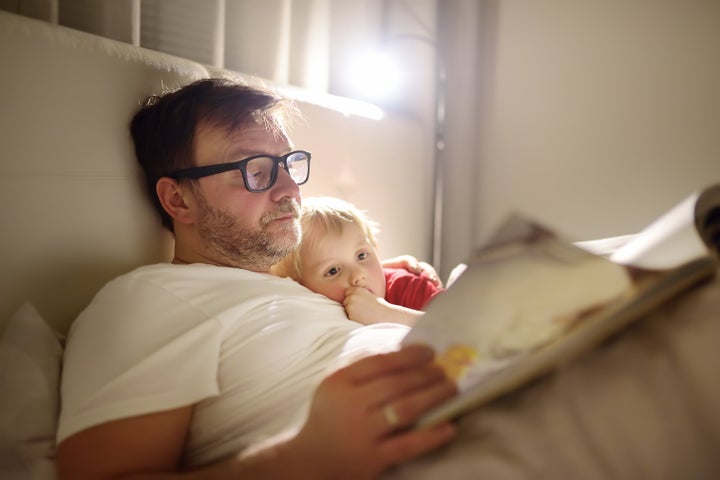
We’ll never get enough of the snuggles that come with bedtime reading.
It’s never too early: As reported in a 2018 HuffPost Canada story, reading to babies during their early infancy boosts language, vocabulary and literacy skills. These benefits are still evident up to four years later.
Most parents continue the bedtime-story routine until their child is around eight years old, and they spend on average 15 minutes reading bedtime stories together. While 21 per cent of parents like to get creative and use their imagination in making up stories, 41 per cent prefer to read from books.