

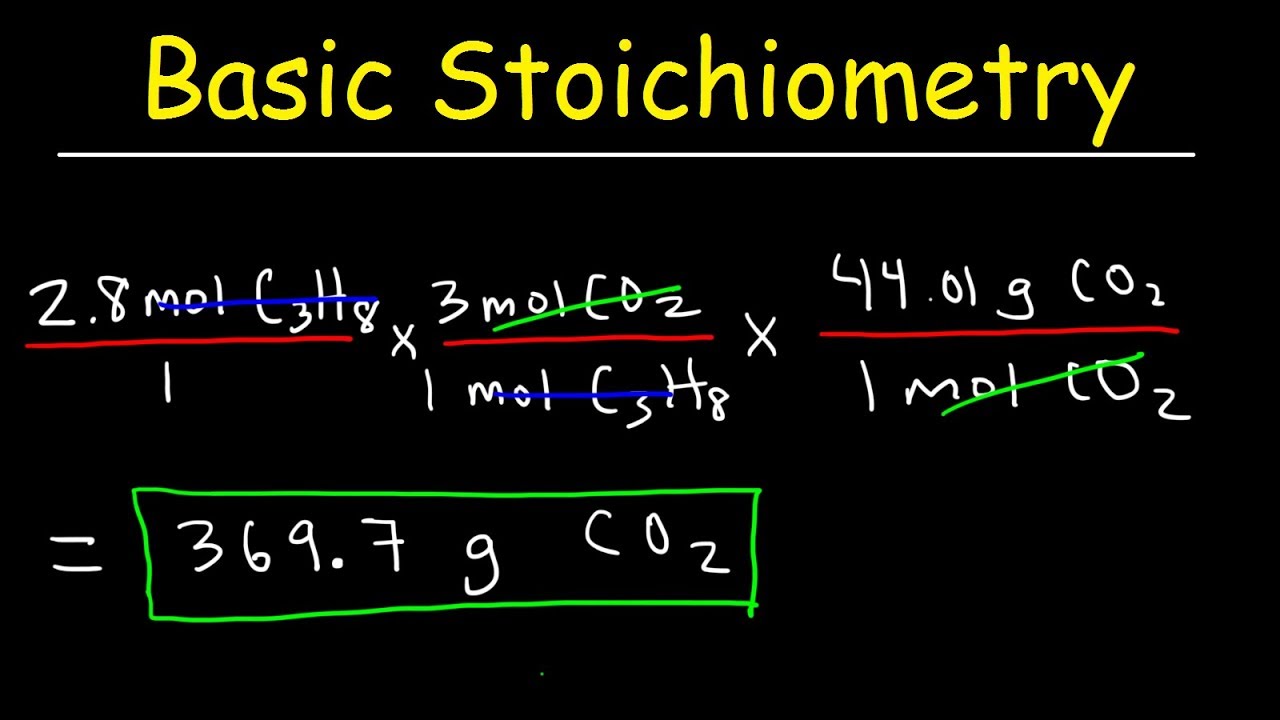
How to Solve Stoichiometry Problems Step by Step

Stoichiometry is one of the most important—and often most challenging—topics in Grade 11 chemistry. Students must combine chemical equations, mole conversions, molar mass and ratios in a single problem. Missing one step can affect the entire calculation.

The good news is that most stoichiometry problems follow the same basic process. Once students understand the sequence and practise using it consistently, even complicated questions become more manageable.

What Is Stoichiometry?

Stoichiometry is the calculation of quantities involved in a chemical reaction. It allows students to determine how much of a reactant is required or how much product can be formed.

A balanced chemical equation provides the relationship between the substances in a reaction. Consider the equation:

2H₂ + O₂ → 2H₂O

This equation tells us that two moles of hydrogen react with one mole of oxygen to produce two moles of water. These coefficients create the mole ratios used in stoichiometry calculations.

It is important to remember that the coefficients represent ratios of particles or moles—not ratios of mass. Students must convert measurements such as grams into moles before applying the coefficient ratio.

The Stoichiometry Road Map

Most stoichiometry problems can be solved using the following route:

Given quantity → Moles of given substance → Moles of required substance → Required unit

The mole acts as the bridge between the two substances. A student may begin with grams, particles, solution volume or gas volume, but the given quantity must normally be converted into moles before the balanced equation can be used.

The following example demonstrates each step.

Example Problem

When hydrogen reacts with oxygen, water is produced:

2H₂ + O₂ → 2H₂O

If 8.00 grams of oxygen react with excess hydrogen, how many grams of water can be produced?

Step 1: Write and Balance the Chemical Equation

Always begin with the correct balanced equation. If the equation is not balanced, the mole ratio will be incorrect.

For this reaction, the balanced equation is:

2H₂ + O₂ → 2H₂O

There are four hydrogen atoms and two oxygen atoms on each side of the equation.

Students should never change the subscripts in a chemical formula when balancing an equation. Changing H₂O to another formula would change the identity of the substance. Only coefficients placed in front of formulas may be adjusted.

Step 2: Identify the Given and Required Quantities

Write down what the question provides and what it asks you to find.

Given: 8.00 g O₂
Required: Mass of H₂O in grams

Organizing this information prevents students from solving for the wrong substance or stopping before reaching the requested unit.

It is also helpful to underline phrases such as “excess hydrogen.” This tells us that there is more than enough hydrogen available, so oxygen determines the amount of water produced.

Step 3: Convert the Given Quantity Into Moles

The problem gives the mass of oxygen, but the balanced equation uses moles. To convert grams into moles, divide by the molar mass.

The molar mass of O₂ is:

2 × 16.00 g/mol = 32.00 g/mol

Now calculate the number of moles:

8.00 g O₂ ÷ 32.00 g/mol = 0.250 mol O₂

Writing the units throughout the calculation helps confirm that grams cancel and moles remain.

Step 4: Apply the Mole Ratio

Use the coefficients from the balanced equation to convert moles of the given substance into moles of the required substance.

The equation shows:

1 mol O₂ : 2 mol H₂O

Therefore:

0.250 mol O₂ × 2 mol H₂O ÷ 1 mol O₂ = 0.500 mol H₂O

The units of moles of oxygen cancel, leaving moles of water.

This is the step that connects the two different substances. Students should always take the mole ratio directly from the balanced equation rather than assuming the ratio is one-to-one.

Step 5: Convert Moles Into the Required Unit

The question asks for grams of water, so the final step is to convert moles of H₂O into mass.

The molar mass of water is:

2(1.01) + 16.00 = 18.02 g/mol

Now multiply:

0.500 mol H₂O × 18.02 g/mol = 9.01 g H₂O

Therefore, 8.00 grams of oxygen can produce:

9.01 grams of water

Step 6: Check the Answer

Before submitting an answer, students should ask several questions:

  • Is the chemical equation balanced?
  • Did I convert the given quantity into moles?
  • Did I use the correct coefficients in the mole ratio?
  • Did I convert the result into the unit requested?
  • Do the units cancel correctly?
  • Did I use an appropriate number of significant figures?

A final answer should always include a numerical value, a unit and the correct chemical substance.

The mass of water being greater than the original mass of oxygen is reasonable because hydrogen also contributes mass to the water produced.

What If Two Reactants Are Given?

When a problem provides quantities for two reactants, students may need to identify the limiting reactant. The limiting reactant is the substance that is used up first and therefore determines the maximum amount of product that can form.

A reliable method is to calculate how much product each reactant could produce separately. The reactant that produces the smaller amount of product is the limiting reactant. That smaller value is used as the theoretical yield.

Students should not choose the reactant with the smaller mass automatically. Different substances have different molar masses and react according to the mole ratio in the balanced equation.

Common Stoichiometry Mistakes

Many incorrect answers are caused by small procedural errors rather than a complete lack of understanding. Common mistakes include:

  • Using an unbalanced chemical equation
  • Applying coefficients directly to grams instead of moles
  • Calculating molar mass incorrectly
  • Reversing the mole ratio
  • Confusing subscripts with coefficients
  • Forgetting to convert millilitres to litres
  • Rounding too early during a multi-step calculation
  • Leaving out units or chemical formulas

Students can prevent many of these mistakes by showing all their work and keeping units attached to every value.

How to Improve at Stoichiometry

Stoichiometry requires practice, but practice should progress gradually. Students should first master molar mass and basic mole conversions before moving to multi-step reaction problems.

It is helpful to use the same road map for every question and label each stage. Once the process becomes familiar, students can work on more advanced questions involving limiting reactants, percentage yield, solutions and gases.

A private chemistry tutor can identify whether a student is struggling with the chemistry, the mathematical calculations or the organization of the solution. The Tutoring Expert provides personalized in-home and online chemistry tutoring for Ontario students, including support with SCH3U stoichiometry and other Grade 11 chemistry topics.

By balancing the equation, converting to moles, applying the mole ratio and converting to the required unit, students can approach stoichiometry problems with greater accuracy and confidence.

SCH3U Grade 11 Chemistry: Topics Students Find Most Difficult

SCH3U Grade 11 Chemistry is often a student’s first course dedicated entirely to chemistry. It introduces abstract scientific ideas, mathematical calculations, laboratory investigations and new terminology — all at a considerably faster pace than Grade 10 science.

Students who succeeded in earlier science courses may initially be surprised by the level of detail and problem-solving required. Understanding which SCH3U topics commonly cause difficulty can help students recognize learning gaps early and develop effective study strategies before those gaps begin affecting their grades.

What Does SCH3U Grade 11 Chemistry Cover?

SCH3U is Ontario’s Grade 11 university-preparation chemistry course. The curriculum explores the properties of matter, chemical bonding, chemical reactions, quantitative relationships, solutions, solubility, gases and atmospheric chemistry.

The course is generally divided into five major units:

  • Matter, chemical trends and chemical bonding
  • Chemical reactions
  • Quantities in chemical reactions
  • Solutions and solubility
  • Gases and atmospheric chemistry

Each unit builds upon concepts introduced earlier in the course. A weakness in atomic structure or chemical formulas, for example, can make balancing equations and completing stoichiometry calculations much more difficult later.

Atomic Structure and Periodic Trends

Students begin SCH3U by developing a more detailed understanding of atoms, elements and the periodic table. They examine electron arrangements, isotopes, atomic radius, ionization energy and electronegativity.

Periodic trends can be difficult because students must understand why properties change across a period or down a group. Memorizing the direction of each trend may help temporarily, but it does not prepare students to explain the trend or apply it to an unfamiliar element.

Students should connect each trend to atomic structure. For example, changes in nuclear charge, electron shielding and the distance between electrons and the nucleus help explain patterns in atomic radius and ionization energy.

Creating a clearly labelled periodic table that shows the direction of each trend can be helpful. Students should then practise comparing pairs of elements and explaining their reasoning rather than simply identifying which element has the larger value.

Chemical Bonding and Molecular Structure

Chemical bonding requires students to connect several ideas at once. They must distinguish between ionic and covalent bonds, draw Lewis structures, predict molecular shapes and relate bonding to the physical properties of substances.

One common problem is treating each task as a separate procedure. In reality, the number of valence electrons influences bonding, the arrangement of bonds affects molecular shape, and molecular structure helps determine properties such as polarity and solubility.

Students can improve by following a consistent process: count the valence electrons, select a central atom, draw the bonds, distribute the remaining electrons and check that the structure is reasonable. Models and diagrams are especially useful because bonding is difficult to understand through written definitions alone.

Students should also practise naming compounds and writing chemical formulas. These foundational skills are used throughout every later SCH3U unit.

Predicting and Balancing Chemical Reactions

In the chemical reactions unit, students classify reactions, predict products and balance chemical equations. Common reaction types include synthesis, decomposition, single displacement, double displacement, combustion and neutralization.

Many students can balance an equation once the correct formulas are provided but struggle to predict the products. Others change subscripts while balancing, which changes the identities of the substances instead of adjusting their quantities.

Students should first confirm that every chemical formula is correct. They can then count the atoms on each side of the equation and adjust only the coefficients. Keeping an organized element-by-element count reduces errors.

Reaction patterns should be understood rather than memorized without context. Students must also learn to use tools such as the activity series and solubility rules when determining whether a reaction will occur.

The Mole and Stoichiometry

Quantities in chemical reactions is frequently the most challenging SCH3U unit. Students are introduced to the mole concept, Avogadro’s constant, molar mass, empirical formulas, molecular formulas, limiting reactants and percentage yield.

These topics require students to combine chemistry knowledge with algebra, ratios and unit conversions. A single mistake early in a multi-step calculation can affect the entire solution.

Before attempting stoichiometry, students should become comfortable converting between mass, moles and numbers of particles. Writing units beside every value makes it easier to identify the required conversion.

For a stoichiometry problem, students can follow a consistent sequence:

  1. Write and balance the chemical equation.
  2. Convert the given quantity into moles.
  3. Use the coefficients to determine the mole ratio.
  4. Convert the resulting moles into the requested unit.
  5. Check whether the answer is reasonable.

Students should show every step instead of completing several calculations mentally. This makes errors easier to identify and can help them earn partial marks even if the final answer is incorrect.

Solutions, Concentration and Solubility

The solutions unit includes molar concentration, dilution, solubility curves, net ionic equations, acids, bases and solution stoichiometry.

Students often confuse the amount of solute with the concentration of a solution. A larger volume does not necessarily mean a greater concentration; concentration depends on the relationship between the amount of solute and the total solution volume.

Drawing a simple diagram or listing the known values before selecting a formula can prevent confusion. Students should also check that volumes are expressed in the correct units, especially when formulas require litres rather than millilitres.

Solubility curves require careful graph reading. Students must identify the correct substance, temperature and quantity before deciding whether a solution is saturated, unsaturated or supersaturated.

Gas Laws and Atmospheric Chemistry

The gases unit connects pressure, volume, temperature and amount of gas through relationships such as Boyle’s law, Charles’s law, the combined gas law and the ideal gas law.

The formulas themselves are usually not the main difficulty. Problems occur when students select the wrong relationship, use inconsistent pressure units or forget to convert Celsius temperatures to Kelvin.

Before calculating, students should write down each variable and identify what remains constant. They should then select the equation containing the known values and the unknown quantity. Keeping units visible throughout the calculation makes errors easier to detect.

Understanding how changing one variable affects another is equally important. Students should be able to predict what will happen to a gas before using a formula to confirm the result.

How Students Can Succeed in SCH3U

Chemistry is best learned through consistent problem-solving rather than memorization immediately before a test. Students should review class notes regularly, complete practice questions and correct mistakes instead of simply checking the final answer.

Creating a formula sheet can be useful, but students should include explanations of when each formula applies. Flash cards are helpful for terminology, ions and reaction types, while multi-step practice is necessary for calculations.

Students should seek help as soon as they notice repeated difficulty. Because the units are connected, unresolved problems with formulas, equations or mole conversions can continue throughout the course and make SCH4U Grade 12 Chemistry significantly harder.

A private chemistry tutor can identify the exact step causing confusion, strengthen missing math skills and guide students through increasingly challenging problems. The Tutoring Expert provides personalized in-home and online SCH3U tutoring for Ontario students. With early support and regular practice, students can develop the knowledge and problem-solving skills needed to succeed in Grade 11 Chemistry.

The Most Difficult Topics in MTH1W — and How Students Can Master Them

Ontario’s MTH1W Grade 9 math course introduces students to a wide range of concepts, including algebra, linear relations, geometry, data, coding and financial literacy. It also asks students to solve unfamiliar problems, explain their reasoning and connect mathematics to real-life situations.

For many students, the greatest challenge is not a single unit. Difficulties often arise when new concepts depend on foundational skills that were not fully mastered in earlier grades. Understanding which topics commonly cause problems—and how to approach them—can help students build confidence and avoid falling behind.

1. Fractions, Integers and Exponents

Strong number skills are essential throughout MTH1W. Students work with positive and negative numbers, fractions, decimals, percentages, powers and square roots. These skills appear in almost every other part of the course.

A student may understand how to solve an equation but still get the wrong answer because of an error involving a negative sign or fraction. When these mistakes happen repeatedly, students may incorrectly believe they do not understand algebra.

The best way to improve number skills is through short, regular practice. Students should review the rules for integers, practise calculations with fractions and learn to estimate answers before using a calculator. Estimation helps students recognize when a calculated answer is unreasonable.

Rather than memorizing rules without context, students should also use number lines, diagrams and worked examples to understand why the rules work.

2. Solving Algebraic Equations and Inequalities

Algebra is one of the most important parts of MTH1W Grade 9 math. Students simplify expressions, solve equations and inequalities, and use variables to represent unknown quantities.

Algebra becomes difficult when students try to memorize steps without understanding the goal of the process. For example, students may know they are supposed to “move a number to the other side” but not understand that they must perform the same operation on both sides to keep the equation balanced.

Students can improve by writing every step clearly and checking their answers through substitution. Once an equation has been solved, the student should replace the variable with the answer and confirm that both sides are equal.

It is also helpful to begin with simple equations and gradually introduce fractions, brackets and variables on both sides. Skipping directly to complex problems can increase frustration and make it harder to identify the exact skill that needs improvement.

3. Understanding Linear and Non-Linear Relations

The Ontario MTH1W curriculum requires students to compare and represent relationships using graphs, tables of values and equations. Students must also recognize the difference between linear and non-linear relations.

Many students can complete a table or plot points but struggle to understand how the representations connect. They may not recognize that the rate of change and initial value in an equation also appear in its table and graph.

To master this unit, students should take one relationship and represent it in several ways. They can begin with a real-world situation, create a table, write an equation and then draw the graph. Afterward, they should explain what each value means in the original situation.

Graphing technology can help students test equations and observe patterns, but it should support understanding rather than replace it. Students should still be able to explain why a graph has a particular shape and what its features represent.

4. Translating Word Problems Into Mathematics

Word problems are challenging because they require both reading comprehension and mathematical reasoning. Students must determine what information is relevant, identify the unknown quantity and choose an appropriate strategy.

A useful first step is to read the problem without immediately searching for an operation. Students can then underline important information, define a variable and restate the question in their own words.

Drawing a diagram, building a table or writing a short list of known and unknown quantities can make complicated questions easier to understand. Students should also include units in their work and write a final sentence that answers the original question.

Regular exposure to different types of word problems is important. Memorizing one example will not prepare students for a question presented in a new context.

5. Geometry and Measurement

Geometry questions often combine diagrams, formulas, algebra and multi-step reasoning. Students may need to calculate an unknown length before determining an area or volume.

Students sometimes focus on memorizing formulas without learning when to use them. A better approach is to label the diagram, identify the required measurement and write the relevant formula before substituting any numbers.

Students should also pay close attention to units. Length is measured in linear units, area in square units and volume in cubic units. Converting measurements at the wrong stage or forgetting units can lead to lost marks even when the main calculation is correct.

6. Data, Probability and Financial Literacy

Data and financial literacy problems may look practical, but they still require careful mathematical thinking. Students analyze graphs, examine data, calculate probabilities and explore financial situations involving percentages, budgets and interest.

These questions become difficult when students rush to calculate before understanding what the numbers represent. A percentage increase, for example, is different from finding the percentage one value represents of another.

Students should identify the starting amount, the rate and the period involved before choosing a formula or calculation. Spreadsheets can be useful for comparing financial scenarios, while hand calculations help students understand how the values are produced.

When analyzing data, students should ask where the information came from, whether the sample is representative and whether the graph presents the information fairly.

7. Coding and Mathematical Modelling

Some students feel nervous when they encounter coding because they assume previous programming experience is required. In MTH1W, coding is primarily used to explore patterns, automate calculations and model mathematical relationships.

Students should begin with small tasks and examine what each line of code does. When a program does not work, they can test one section at a time instead of changing everything at once.

Learning to identify and correct errors is part of the process. Coding can actually strengthen mathematical reasoning by encouraging students to organize instructions logically and predict what should happen.

How Students Can Succeed in MTH1W

The most effective strategy is consistent practice. Completing a few problems several times per week is generally more beneficial than studying for several hours immediately before a test.

Students should keep track of mistakes and categorize them. Was the error caused by a misunderstood concept, an incorrect calculation, a misread question or a skipped step? Recognizing patterns helps students focus their practice.

It is also important to ask questions early. Because MTH1W concepts build on one another, confusion in one unit can affect performance later in the course and on the Grade 9 EQAO math assessment.

A private math tutor can identify missing foundational skills, explain difficult concepts in a different way and provide practice at the appropriate level. Individual support also gives students more time to ask questions and work through mistakes without feeling rushed.

The Tutoring Expert provides personalized in-home and online MTH1W tutoring for Ontario students. With targeted instruction, regular practice and early support, students can master challenging Grade 9 math topics and build a strong foundation for future high-school courses.