

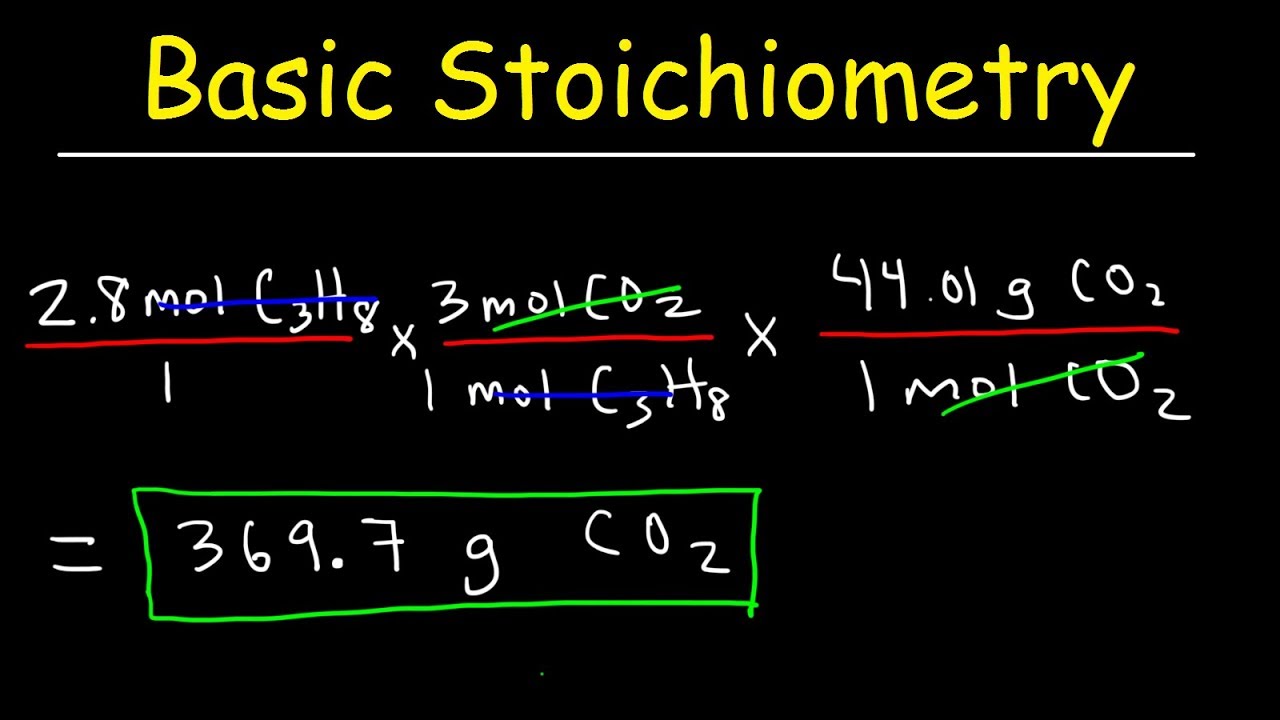
Stoichiometry is one of the most important—and often most challenging—topics in Grade 11 chemistry. Students must combine chemical equations, mole conversions, molar mass and ratios in a single problem. Missing one step can affect the entire calculation.
The good news is that most stoichiometry problems follow the same basic process. Once students understand the sequence and practise using it consistently, even complicated questions become more manageable.
What Is Stoichiometry?
Stoichiometry is the calculation of quantities involved in a chemical reaction. It allows students to determine how much of a reactant is required or how much product can be formed.
A balanced chemical equation provides the relationship between the substances in a reaction. Consider the equation:
2H₂ + O₂ → 2H₂O
This equation tells us that two moles of hydrogen react with one mole of oxygen to produce two moles of water. These coefficients create the mole ratios used in stoichiometry calculations.
It is important to remember that the coefficients represent ratios of particles or moles—not ratios of mass. Students must convert measurements such as grams into moles before applying the coefficient ratio.
The Stoichiometry Road Map
Most stoichiometry problems can be solved using the following route:
Given quantity → Moles of given substance → Moles of required substance → Required unit
The mole acts as the bridge between the two substances. A student may begin with grams, particles, solution volume or gas volume, but the given quantity must normally be converted into moles before the balanced equation can be used.
The following example demonstrates each step.
Example Problem
When hydrogen reacts with oxygen, water is produced:
2H₂ + O₂ → 2H₂O
If 8.00 grams of oxygen react with excess hydrogen, how many grams of water can be produced?
Step 1: Write and Balance the Chemical Equation
Always begin with the correct balanced equation. If the equation is not balanced, the mole ratio will be incorrect.
For this reaction, the balanced equation is:
2H₂ + O₂ → 2H₂O
There are four hydrogen atoms and two oxygen atoms on each side of the equation.
Students should never change the subscripts in a chemical formula when balancing an equation. Changing H₂O to another formula would change the identity of the substance. Only coefficients placed in front of formulas may be adjusted.
Step 2: Identify the Given and Required Quantities
Write down what the question provides and what it asks you to find.
Given: 8.00 g O₂
Required: Mass of H₂O in grams
Organizing this information prevents students from solving for the wrong substance or stopping before reaching the requested unit.
It is also helpful to underline phrases such as “excess hydrogen.” This tells us that there is more than enough hydrogen available, so oxygen determines the amount of water produced.
Step 3: Convert the Given Quantity Into Moles
The problem gives the mass of oxygen, but the balanced equation uses moles. To convert grams into moles, divide by the molar mass.
The molar mass of O₂ is:
2 × 16.00 g/mol = 32.00 g/mol
Now calculate the number of moles:
8.00 g O₂ ÷ 32.00 g/mol = 0.250 mol O₂
Writing the units throughout the calculation helps confirm that grams cancel and moles remain.
Step 4: Apply the Mole Ratio
Use the coefficients from the balanced equation to convert moles of the given substance into moles of the required substance.
The equation shows:
1 mol O₂ : 2 mol H₂O
Therefore:
0.250 mol O₂ × 2 mol H₂O ÷ 1 mol O₂ = 0.500 mol H₂O
The units of moles of oxygen cancel, leaving moles of water.
This is the step that connects the two different substances. Students should always take the mole ratio directly from the balanced equation rather than assuming the ratio is one-to-one.
Step 5: Convert Moles Into the Required Unit
The question asks for grams of water, so the final step is to convert moles of H₂O into mass.
The molar mass of water is:
2(1.01) + 16.00 = 18.02 g/mol
Now multiply:
0.500 mol H₂O × 18.02 g/mol = 9.01 g H₂O
Therefore, 8.00 grams of oxygen can produce:
9.01 grams of water
Step 6: Check the Answer
Before submitting an answer, students should ask several questions:
- Is the chemical equation balanced?
- Did I convert the given quantity into moles?
- Did I use the correct coefficients in the mole ratio?
- Did I convert the result into the unit requested?
- Do the units cancel correctly?
- Did I use an appropriate number of significant figures?
A final answer should always include a numerical value, a unit and the correct chemical substance.
The mass of water being greater than the original mass of oxygen is reasonable because hydrogen also contributes mass to the water produced.
What If Two Reactants Are Given?
When a problem provides quantities for two reactants, students may need to identify the limiting reactant. The limiting reactant is the substance that is used up first and therefore determines the maximum amount of product that can form.
A reliable method is to calculate how much product each reactant could produce separately. The reactant that produces the smaller amount of product is the limiting reactant. That smaller value is used as the theoretical yield.
Students should not choose the reactant with the smaller mass automatically. Different substances have different molar masses and react according to the mole ratio in the balanced equation.
Common Stoichiometry Mistakes
Many incorrect answers are caused by small procedural errors rather than a complete lack of understanding. Common mistakes include:
- Using an unbalanced chemical equation
- Applying coefficients directly to grams instead of moles
- Calculating molar mass incorrectly
- Reversing the mole ratio
- Confusing subscripts with coefficients
- Forgetting to convert millilitres to litres
- Rounding too early during a multi-step calculation
- Leaving out units or chemical formulas
Students can prevent many of these mistakes by showing all their work and keeping units attached to every value.
How to Improve at Stoichiometry
Stoichiometry requires practice, but practice should progress gradually. Students should first master molar mass and basic mole conversions before moving to multi-step reaction problems.
It is helpful to use the same road map for every question and label each stage. Once the process becomes familiar, students can work on more advanced questions involving limiting reactants, percentage yield, solutions and gases.
A private chemistry tutor can identify whether a student is struggling with the chemistry, the mathematical calculations or the organization of the solution. The Tutoring Expert provides personalized in-home and online chemistry tutoring for Ontario students, including support with SCH3U stoichiometry and other Grade 11 chemistry topics.
By balancing the equation, converting to moles, applying the mole ratio and converting to the required unit, students can approach stoichiometry problems with greater accuracy and confidence.